AltoSignal for eye care
A technician finishes the work-up and the doctor knows. A patient is dilating and every screen shows the clock. The optician is needed in the contact lens room and nobody shouts down the hall. AltoSignal runs on the tablets, desktops and phones your practice already owns, and it draws your rooms as a floor plan with every patient and staff member in them.
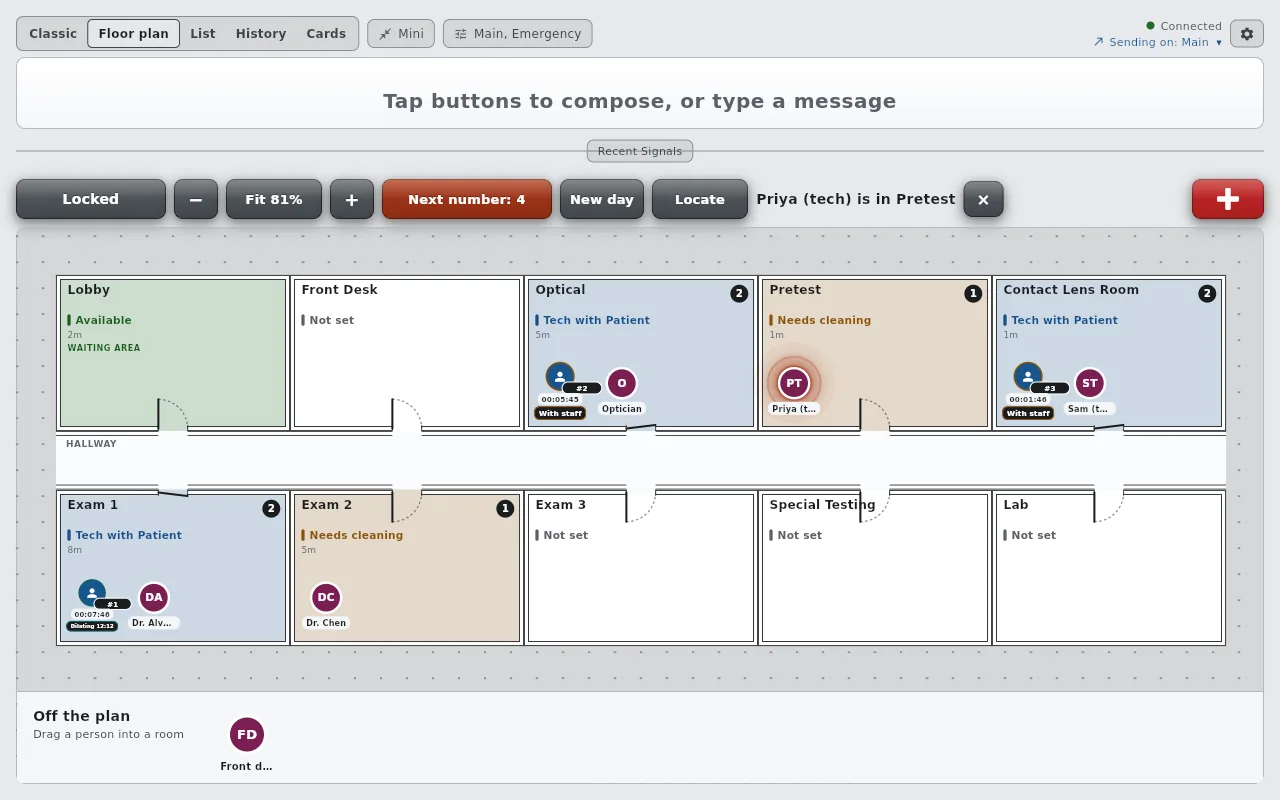
A patient in an eye care practice moves more than a patient anywhere else.
Pretest, then the lane, then dilation, then back to the lane, then optical or the contact lens room. Four rooms and three staff members in forty minutes, and a clock in the middle that nobody can see from the shop floor. A wall light says a room needs someone. It does not say who, or for what, or how long the drops have been in.
AltoSignal was built for staff to signal each other without a sound in the room they are signaling into. In 4.0 it learned to follow the patient too: a number at the door, a room on the plan, a state with a timer, and a history of the day. The screens below are the shipping app on a Fire HD 10 tablet in Exam 1 and the desktop app at the front desk, on a demo account seeded as a one-doctor optometry office.
Every clip is real time on real screens: the Exam 1 tablet on the left, the front desk on the right.
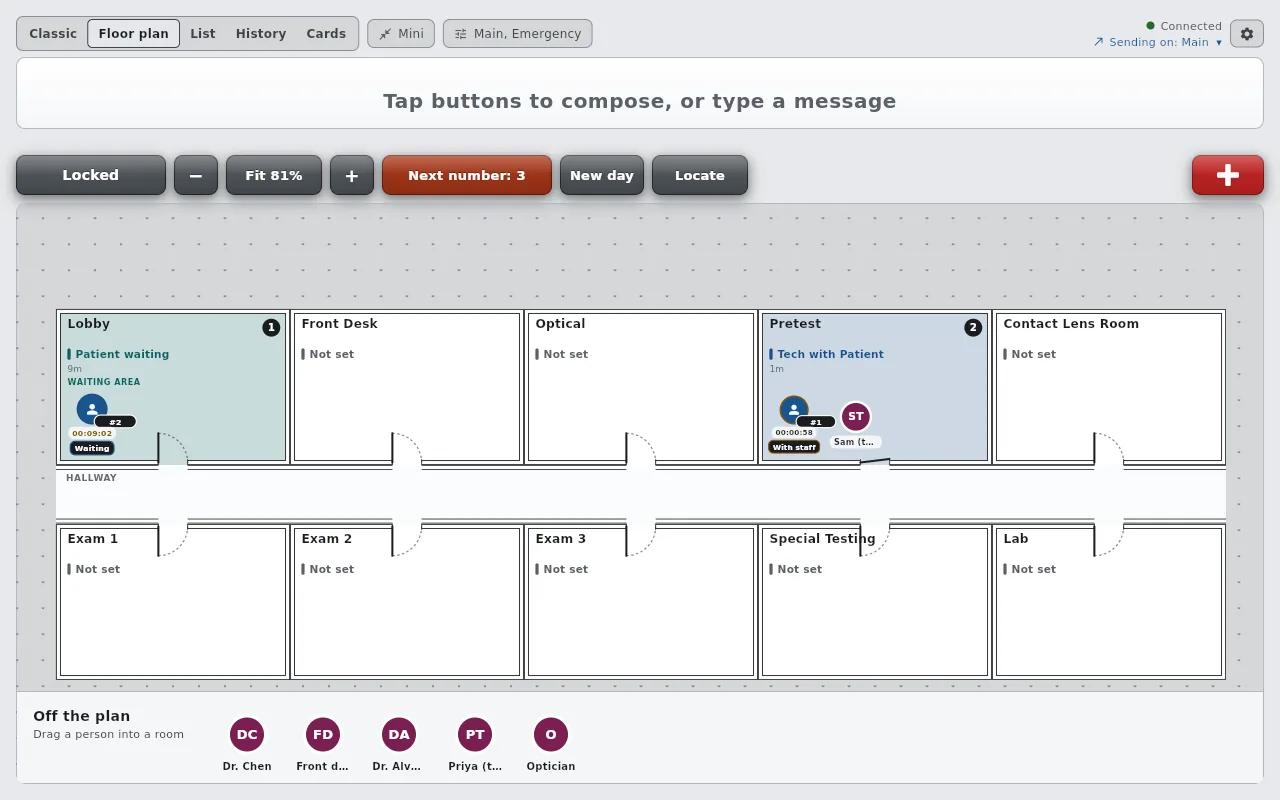
The moment Sam and the patient enter Pretest, the room turns Tech with Patient on every screen and the patient's clock starts. The next patient waits in the lobby with a clock of their own. Nobody typed anything.
Room states are words you choose. The eye care starter set uses Available, Tech with Patient, Needs cleaning, Patient waiting and Out of service.
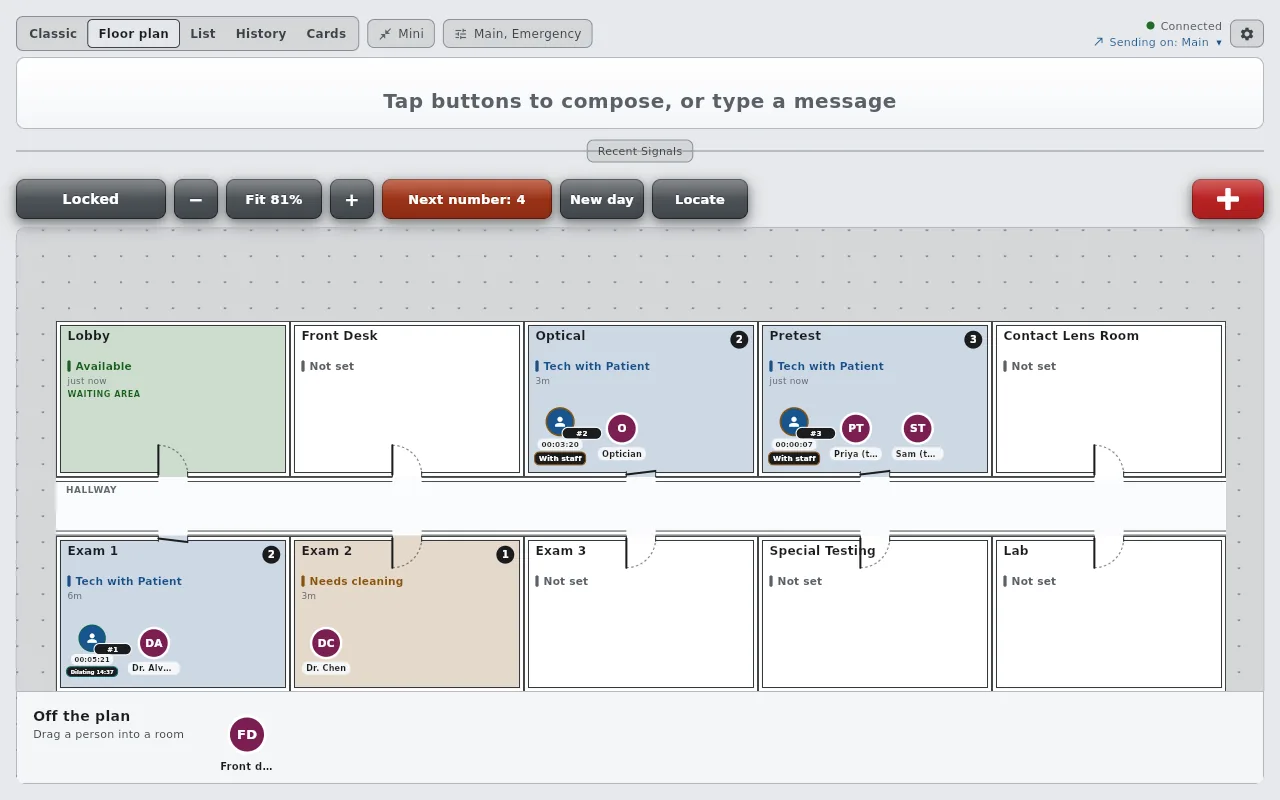
An eye care group told us about patients who sat dilated for fifty minutes because a doctor forgot, and about the reviews that followed. The only timer they had lived on one machine in one room. That is why Dilating is a patient state here, not a room state, and why the countdown lives on the patient's card on every screen.
Twenty minutes is the starter value. Change it to twelve, or thirty, in Button Setup, and every device on the account follows.
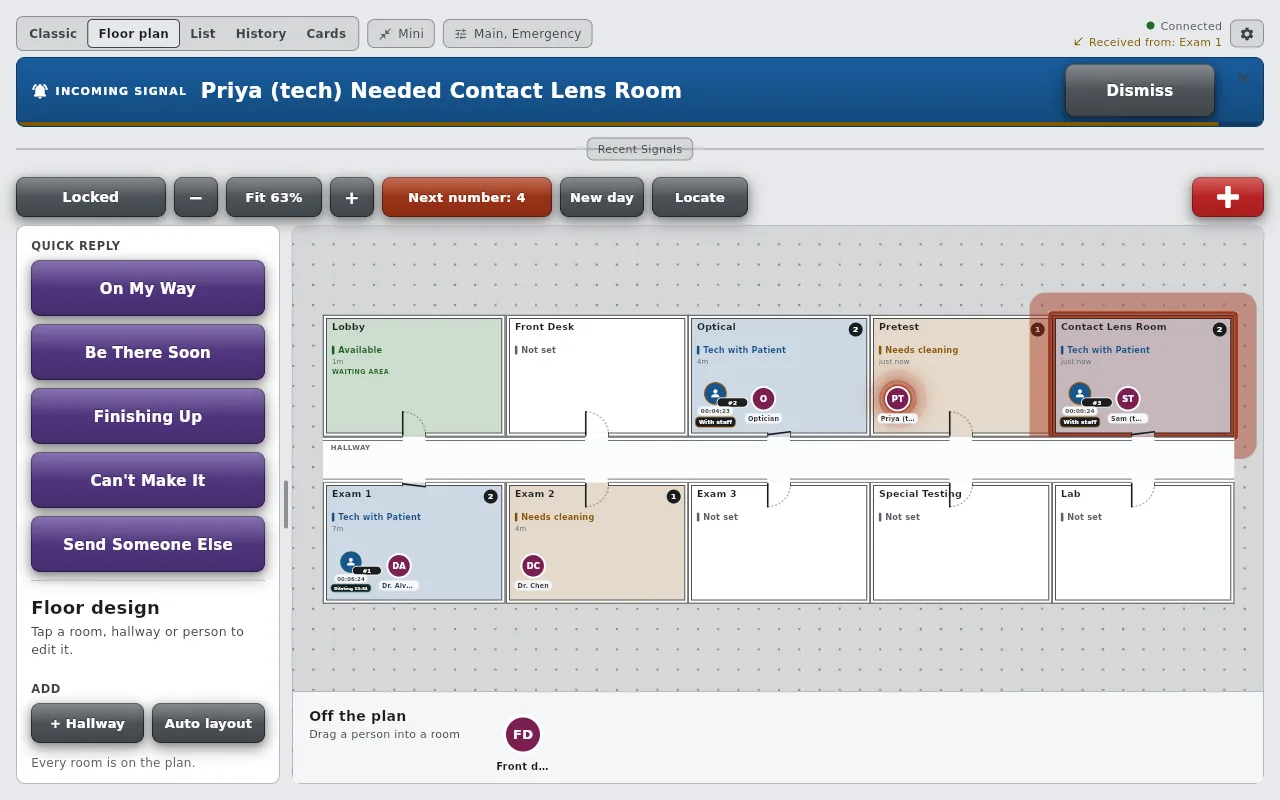
Every signal names a person, a need and a room, in your own words. The room lights up on the plan. The person who takes it answers with one press, and when the sender acknowledges the reply it clears on every screen. Nobody wonders whether the page was seen.
Channels keep the noise where it belongs: the eye care starter set adds an Optical channel so lane traffic never reaches the front desk unless you want it to.
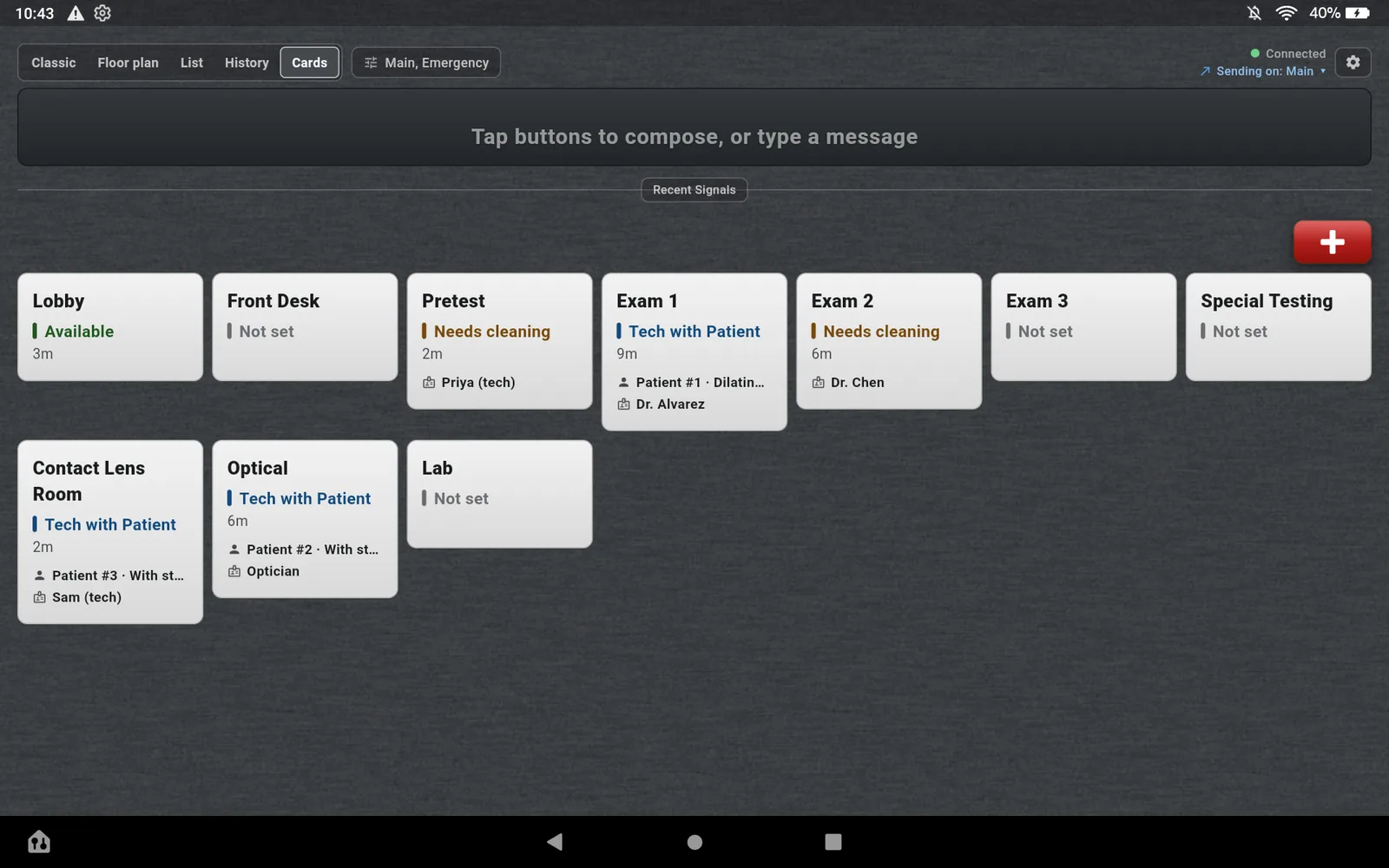
The front desk runs the floor plan. A lane tablet runs the Classic buttons or the Cards. A technician's phone runs the List. History is the signal board itself. Every view sees the same rooms, people and patients, and the choice is remembered per device.
The full 4.0 tour walks through the plan, take a number, timers, history and New day.
The eye care starter set, ready on a new account. Rename anything, add rooms, or reset to it at any time.
Where
Who and what
States
The room names came from a real practice: ten rooms, four doctors, technicians, opticians and contact lens staff, whose manager built her first board on a trial with the states ready, dilating and done before we had shipped any of this. If your practice says lane, or test room, or pre-screen, type that instead.
The 4.0 features on this page exist because of two conversations in September 2026.
"If you guys had the dilation timers, I would immediately bring it up in our next meeting: talk to these people now, because they have what we're all looking for."
The IT manager of a 26-location eye care group, on a call in September 2026
The practice manager on the same call put it as "a dilation button, twelve minutes, and once it's ready it pings." Her lead technician had used the old Windows light system for twelve years and asked when the new one was coming. The IT manager had a different complaint too: that system flooded the network with multicast traffic and knocked out the phones, and its vendor told him it still ran on .NET 4. That story is why AltoSignal's local network delivery can be switched off per screen or for the whole practice, and why it is documented for IT before anyone asks.
Most eye care practices are running one of these today.
A light outside the lane, or a Windows program that turns a lamp on and off. The meaning lives in how the light behaves: solid means the patient is ready, blinking means the tech is in. New staff learn the code; everybody else guesses. See the Comlite comparison.
A six-button box in each test room that texts a pager on an assistant's belt. The optometrist presses Dispense or Contact Lenses, the first free assistant swipes to clear it. No room status, no floor plan, no history, and a box, a pager and a battery to buy for each of them. See the OptiCall comparison.
A status column in the EHR that somebody has to be looking at. It works until the doctor is in a lane with the chart closed. AltoSignal is a separate screen that never holds patient data, so it can sit beside the EHR on the same desktop without touching it.
The ones eye care practices ask before a trial.
No, and that is deliberate. AltoSignal holds no patient names, charts or PHI. A patient on the board is a number, an optional short label such as initials, the rooms they have been in and the times. Staff signal each other with buttons that say who, what and where. There is nothing to integrate, nothing to install on the practice management server, and a BAA is available on request.
Dilating is a patient state with a countdown, 20 minutes in the eye care starter set and any number of minutes you choose in Button Setup. When a technician marks the patient Dilating, every screen on the account shows the same clock on that patient. When it runs out the patient's card pulses red on every screen until somebody changes the state. The clock keeps counting past zero, so a doctor can see a patient has been ready for six minutes, not just that the timer ended.
No. AltoSignal runs on the screens you already own: the desktop in each lane, the iPads the technicians carry, an Android or Amazon Fire tablet at the front desk, a phone in an optician's pocket, or a browser on any computer. Billing is per device, so a practice with three lanes, pretest, a contact lens room and optical typically runs six to ten devices. Staff seats are unlimited.
Today each location runs its own account with its own rooms, staff and floor plan, and one person can sign in to all of them. Per-user logins with roles, and single sign-on for larger groups, are the next thing we are building. If you manage several practices, tell us at sales@altosignal.com and we will show you where that work stands.
AltoSignal is priced per device, and the rate drops as you add devices. $25 a month covers your first 5 devices; devices 6–10 are $4 each, 11–20 are $3, 21–100 are $2, 101–200 are $1.50, and 201–500 are $1.25. Each band prices only the devices inside it, so an 8-device practice pays $37 a month. Pay yearly and you get two months free. Every plan starts with a 30-day free trial, no credit card.
Yes, inside the practice. Devices running the AltoSignal app on the same network hand signals straight to each other at the same time as the cloud, so the lanes keep paging the floor through an outage. Local delivery can also be switched off per screen or for the whole practice if your IT team prefers every signal to go through the cloud. See how local delivery works.
Pick the eye care starter set on a new account, put the app on the screens you have, and page pretest from a lane before lunch. Cancel anytime, no phone call.
Start 30-day free trialWant the whole 4.0 story first? The floor plan tour · Guides and how-to videos
