AltoSignal vs OptiCall
OptiCall and AltoSignal solve the same problem: the optometrist has finished, and somebody on the floor needs to know without anyone shouting. OptiCall does it with a call box in the test room and a text pager on every belt. AltoSignal does it on the tablets, desktops and phones the practice already owns, with a signal that says who, what and where, a reply the optometrist can see, the state of every room, a floor plan, and a history of the day. Published pricing from $25 a month for 5 devices, and a 30-day free trial.
OptiCall is a paging system from Long Range Systems, sold to opticians in the UK and North America and, in the company's words, "developed specifically for Specsavers UK". A one- or six-button call box sits in each test room, on two AAA batteries or an optional mains kit. The optometrist presses a preset such as Dispense, Fields, Pre-Test, Contact Lenses or Panic, and the box texts a group of alpha pagers: the room's buddies, a manager who then decides who goes, or the whole team, with the first free assistant taking it. Pages repeat until they are cleared down. It is dependable, it needs no Wi-Fi, and it has been in stores for a long time.
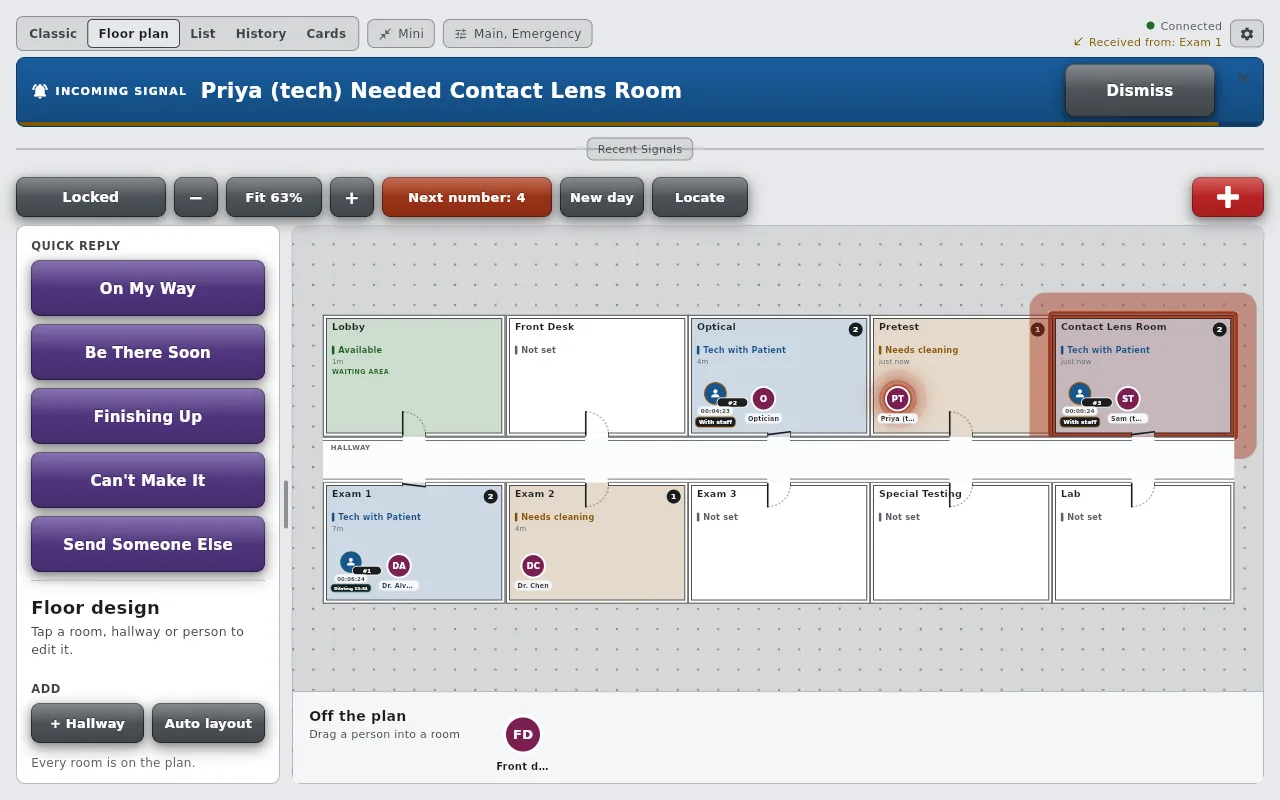
What a pager cannot do is show anything. The assistant sees four words and a room. The optometrist does not see who is coming. The dispensing floor does not see which test rooms are busy, how long a patient has been dilating, or where the contact lens optician has gone. AltoSignal puts all of that on the screens the practice already has: a signal names who, what and where in your own words, the person who takes it replies with one press and the sender acknowledges, every room carries a state, and your rooms are drawn as a floor plan with each patient and staff member in them. Nothing to wire, no batteries, no chargers by the till.
| AltoSignal | OptiCall | |
|---|---|---|
| Type | App on the devices you own, plus a browser version | Hardware: call box transmitters and text pagers |
| In the test room | The desktop already there, or any tablet; the technician's phone on the way out | A one- or six-button call box, wall-mounted or on the desk |
| On the floor | A screen showing every room, and the app on a phone | A pager on each belt (Vibe+ AP2, large screen or watch pager) |
| What the message says | Who, what and where, in your words, plus a free-typed line | One of five or six preset messages per box |
| Who receives it | A channel: everyone, the floor only, a group, or one device | Buddies, a manager, or the whole team, set at install |
| Reply and acknowledge | One-press replies; the sender acknowledges and it clears everywhere | Page repeats until cleared; optional pager text confirming the clear |
| Room status | Every room shows a state, who is in it and for how long | None; a pager shows the message only |
| Patient timers | Dilating with a countdown that turns red on every screen | None |
| Floor plan and history | Rooms drawn as a plan; every patient's and room's day; Locate | None |
| Power and upkeep | Nothing beyond the devices you already charge | AAA batteries per box or a mains kit; pagers on chargers; range extender if needed |
| If the internet is down | Keeps signaling on your own network | Not affected; its own radio |
| Across locations | Works over the internet; one sign-in for every screen | Inside radio range of the transmitter |
| Pricing | $25 / month for 5 devices · 10 devices $45 · 20 devices $75 · two months free billed yearly · 30-day free trial, no card | Not published; quote per site, plus boxes, pagers, chargers and mains kits · 14-day trial · 3-year warranty |
Based on Long Range Systems' publicly available product information as of September 2026 (lrspagers.co.uk, longrangesystems.com and specsaverstraining.co.uk: OptiCall six-button and Butler one-, two- and five-button transmitters; Alpha Vibe+ AP2, large screen and watch pagers; buddy, manager-led, whole-team and hybrid routing; two AAA batteries per OptiCall unit with optional mains kits; pages that repeat until cleared; a 14-day trial and a three-year warranty). The company says its systems are "used throughout Specsavers and Boots" and that OptiCall "was developed specifically for Specsavers UK". "None" means the vendor's material describes no such feature; check with Long Range Systems for current products and pricing. OptiCall, Butler and Long Range Systems are trademarks of their respective owners; AltoSignal is not affiliated with or endorsed by them.
One screen on the dispensing floor shows every test room, who is in it, which patient is dilating and for how long. A page is context, not an interruption, and the next free assistant already knows where to go.
On My Way comes back to the test room in one press. Acknowledge clears it for everyone. The history shows who answered what and when, which a pager swipe never did.
The desktop in the lane, the technician's iPad and a tablet by the till are already there. Adding a room is a name on the plan, not a box, a pager and a battery order.
Both let an optometrist in a test room call an assistant without raising a voice. OptiCall, from Long Range Systems, is hardware: a one- or six-button call box in each test room sends a preset message to text pagers carried by staff, routed to a buddy, a manager or the whole team. AltoSignal is an app on the devices you already own, with native apps for iPhone, iPad, Android, Amazon Fire, Windows, Mac and Linux plus a browser version. A signal says who, what and where, the person who takes it replies and the sender acknowledges, every room shows its state, and your rooms are drawn as a floor plan with each patient and staff member in them.
No. A phone in a pocket runs the same app as the tablet in the test room, and a signal arrives as a notification with the same who, what and where. A screen on the dispensing floor shows every room at once, so staff see a call before it reaches anyone's pocket. There are no pagers, chargers or batteries to buy or replace.
Yes. The person taking the call presses one reply, On My Way or Be There Soon, and it appears on the sender's screen. Acknowledging the reply clears it everywhere. Every signal, reply and acknowledgement is in the history with who and when.
AltoSignal is priced per device, and the rate drops as you add devices. $25 a month covers your first 5 devices; devices 6–10 are $4 each, 11–20 are $3, 21–100 are $2, 101–200 are $1.50, and 201–500 are $1.25. Each band prices only the devices inside it, so a practice with 8 screens pays $37 a month. Pay yearly and you get two months free. Every plan starts with a 30-day free trial, no credit card. Long Range Systems does not publish OptiCall prices; ask them for a quote and count the call boxes, pagers, chargers and mains kits.
It uses the Wi-Fi and the screens the practice already has, and signals travel across your own network and through the cloud at the same time, so an internet outage does not stop the test rooms paging the floor. A pager system uses its own radio, which is its advantage in a building with no Wi-Fi at all; in a practice that already runs its practice management system on the network, that advantage has usually gone. See how local delivery works.
See it working: A morning in an eye care practice · The floor plan · Guides
Pick the eye care starter set on a new account and put the app on the screens you have. No boxes, no pagers, no sales call. Cancel anytime.
Start 30-day free trial